Background
Oh Shoot! Is one of a couple of dozen games that were released by Atariage in the fall of 2025. It was developed by Philip Meyer, his first Atari 2600 game which was inspired by Atari Combat released way back in 1977 and stuffed into a 2K cartridge. I consider that high praise as Combat is one of my personal favorites on the 2600. Initially the game was designed to be a 4K rom with 16 screens. After many optimizations and creative coding, the final release turned out to be a 32K rom with 1024 screens, an amazing technical achievement.
At its core, the game is a one-on-one shoot ’em up. The first player to reach either 20 or 40 points, depending on the selected mode, wins. There are four types of ships, the “Banshee” which resemble jets, the “Rangers” resemble choppers, the “Destroyers” resemble Tie Fighters, and the “Specter” resemble UFOs, each have their own unique projectile behaviors. What makes the game unique is the sheer number of combat screens/environments/playfields coupled with how they can dynamically move into place.
GAME DESCRIPTION:
When you first power on the game, you are greeted by two enlarged, animated spaceships bobbing up and down side by side. The title “Oh Shoot!” appears in gray at the top. At the bottom of the screen, a copyright notice credits Philip Meyer, the games developer. The gray title text periodically flashes white. After a brief moment, the main menu appears, allowing you to select your game settings. On this screen, the game number is shown in the top-left corner, while the number of points required to win is displayed in the top-right.
In the center of the screen, several settings are layered together: ship speed, shot speed, and flight mode. Ship speed can be set to slow or fast, as well as the shot speed which can be standard or “Shot+,” and flight mode to “Manual” or “Auto.” In “Manual mode”, you have full control of your ship and can move freely around the screen. In “Auto mode”, your ship automatically thrusts forward toward the opposite side.
Just below the flight mode there is an small image of an Atari 2600. The number of players is indicated by the number of Atari joysticks displayed. Just under that are player options. Pressing “left” on the player one joystick toggles through the Player One options, while pressing right on the Player One joystick toggles through the Player Two options. The options are as follows:
- Blank – No setting
- “A” – Assistance; it helps the player avoid obstacles
- “A+” – Enhanced assistance; it helps the player avoid obstacles and missiles
- “E” – is for Easy computer opponent
- “N”- is for Normal computer opponent
- “H” – is for Hard computer opponent
Additional game modes include:
- “FX” (Effects Mode) – The screen graphics automatically scroll in and out
- “EX” (Exhibition Mode) – Computer controlled players compete indefinitely with no sound effects. Actually, the “flying” sound effect still remains in effect.
- “EX+” (Exhibition Mode+) – Computer controlled players compete indefinitely with full sound effects
Gameplay revolves around shooting your opponent while avoiding obstacles. If you crash into anything, you die and your opponent scores a point. If both players collide, both are destroyed and each receives a point. The terrain is blocky but forms recognizable patterns, including designs inspired by skylines, forests, castles, as well as homages to old Atari titles.
Single player / Multiplayer / Title Screen / Attract mode
You can play the game either in single player mode against the computer, or two-player mode. There is an optional zero-player mode where the computer will play itself, sort of like an exhibition match that can go to 20 or 40 points or unlimited.
There is sort of an attract mode, as the game will switch between the title screen and the last play field screen. It will color cycle that screen for a while then switches back to the intro screen, randomly displaying the ships.
Gameplay
When the game begins, players are assigned a random aircraft, a “Banshee” , a “Ranger” , a “Destroyer”, or a “Specter, each having it’s own distinct weapon, and are placed on opposite sides of the screen. A random combat screen or playfield is selected from a palette of a staggering 1024 screens. The players can fire projectiles at each other. The environment serves as more than just a backdrop; using the console’s difficulty switches, players can determine whether projectiles pass through barriers or are blocked by the terrain.
The players can freely move around the screen unless “auto mode” is enabled. “Auto mode” will force the ships to thrust forward. Also depending on the game play options, the environment itself may scroll in and out of view and may even have the “ripple” effect as described in the manual. Following every successful kill, the game immediately resets the players to their starting positions with new random ships and a fresh playfield. This process repeats until the game concludes.
Controls
The game is played using a standard CX40 joystick, which handles both movement and firing. The controls feel smooth and reliable.
Most ships shoot straight ahead, but the Banshees let you angle your shots upward or downward. Ranger projectiles have a shorter range, but have double the firing rate of the other ships. The Destroyer fires “magnetic torpedoes” that have a slight tendency to move toward the player. The Specter shots move in a more erratic, wave-like pattern, described in the manual as “neutron pulses”.
For players who need extra help, an AI assist mode is available to aid with dodging incoming fire and avoiding obstacles. This is a really nice feature you don’t see in very many games.
The manual mentions that Oh Shoot! Is “Couch Compliant” meaning the game can be setup, started and exited from the joystick without the need to press any switches on the console. Lending to that, if at any point you want to exit the game and return back to the menu system, temporarily pause your gameplay and rapidly press the fire button eight times, wait for the screen to color cycle. Then press the joystick in any direction to return to the select screen.
Scoring
You earn a point whenever your opponent is destroyed, whether by being shot or crashing into the terrain. The match ends once either 20 or 40 points are reached, depending on the selected game mode. It’s also possible for both players to be eliminated at the same time, with each receiving a point. If the players run into each other both are destroyed and each awarded a point.
Strategy
Players can take advantage of the environment by maneuvering opponents into walls or the ground while evading incoming fire. Optional settings, like disabling the ability to shoot through the terrain, encourage using the landscape for cover instead of simply firing freely. In certain situations, a player in the lead might even resort to a “kamikaze” move, deliberately crashing into their opponent to end the round while maintaining their score advantage. Keep in mind when piloting the Banshee’s you can direct your missiles toward your opponent by moving up or down, like guided smart missiles.
Graphics
I have to say I was surprised right out of the gate with the intro screen showing two animated/moving ships which looked amazing. While the graphics may initially appear basic and evoke the Combat like esthetic, the depth is revealed through the 1,024 unique combat screens that randomly cycle after every point. These screens utilize blocky terrain often forming fascinating and often recognizable patterns.
Additionally, the game features large, animated explosions that provide satisfying feedback whenever a ship is destroyed. All these features when combined, successfully deliver a burst of nostalgia.
The graphics are further enhanced by full screen scrolling and warping effects found in the “FX mode,” which keep the environment dynamic and unpredictable. The “FX” mode is only available in two player mode games. When enabled, the background terrain may scroll in and out of the screen randomly. It is a blast playing with this effect enabled. In my opinion you are not seeing the fullest potential of this game if you do not play with the “FX” mode enabled.
Sound
The original sound engine was gutted and rewritten during development to save space making room for all those combat screen. There are sounds featuring the humming of engines, firing sounds, and the noise of collisions. The sounds are basic, and again, remind me of games like Combat. When the “Destroyers” fire, it sounds lot like when the dragon in Adventure eats the player.
Difficulty switches
The game utilizes the Atari’s physical difficulty switches. Setting the difficulty to ‘A’ can negate the advantage of wavy shots by preventing them from passing through scenery. The left switch controls player one while the right switch controls player 2.
Game variations
The game includes 48 game numbers which are multiplied by the game options which are accessible via the main menu. These settings allow users to customize:
- Number of players from zero to two.
- Flight and missile speeds
- Warping/Morphing effects: “Plus mode” makes the scenery shift psychedelically during play.
- Auto scrolling: Ships move constantly, and players only control altitude.
The Game mode determine the number of players and the score required to win. The manual’s “Game Select Matrices” chart provides the clearest breakdown. Press up or down on the joystick to choose from the following options:
- Modes 1-8: Single-player, 20-point games
- Modes 9-16: Two-player, 20-point games
- Modes 17-24: Zero-player (Game plays itself), 20-point games
- Modes 25-32: Single-player, 40-point games
- Modes 33-40: Two-player, 40-point games
- Modes 41-48: Zero-player, 40-point games
When selecting the game modes you may notice the screen change colors. “Blue” indicates a 20 point game while “Red” indicates a 40 point game. Keep in mind in the “EX” and “EX+” modes the game will play itself forever.
Suggestions for Improvements
When it comes to the ending of a game, although conforming to how Atari 2600 games normally end, It might have been nice to have some sort of an ending screen. Maybe something with the players shot statistics. Some have argued that a tie game should not be possible, but I actually like that it can end that way. Others have suggested there are way too many options for the game, but I strongly disagree. I would much rather have all the options than be confined to a few base settings. The only other thing that I can think of, it would have been nice to have had a “tank” mode homage.
Easter eggs
I spotted a few combat screens that resembled scenes that were throwbacks to, “Space Invaders”, “Combat”, “Pac-Man”, “Berzerk”, “Outlaw”, and “Adventure”.
I have compiled the following list that I would consider “features” but some would consider them to be easter eggs, because it is not always obvious how to initiate them:
- The most obvious one I would say is the “Black and White Switch Support”. Philip considers this an Easter egg of sorts because, while it was a standard part of the original Atari experience, modern players rarely toggle this switch.
- “Title Screen Reset Mode” – On the title screen, pressing right on the joystick activates a hidden mode where the title text turns blue. In this mode, the title screen will automatically reset every 20 seconds, while the text flashes gray every five seconds. It can be reset immediately by tapping right again. This allows players to cycle through different versions of the title screen. Do this to find your favorite combination of ships and watch the animations.
- “Rapid Screen Browsing” – Players can rapidly cycle through the game’s 1,024 unique screens, by holding down the reset button. If the game is set to “EX” mode while doing this, most of the games sound effects are disabled.
Podcasts / Other Video Review coverage
Oh Shoot! has received detailed media coverage from several retro gaming sources, including written reviews, blog features, and video reviews.
Written Reviews and Blogs
- The Video Game Critic: On June 20, 2025, awarded the game a rare ‘A’ grade. It was praised for its “pick-up-and-play simplicity,” expert programming, and high-definition title screen, ultimately calling it a “remarkable homebrew”.
- The Indie Gamer Chick, in a review published on May 20, 2025, gave the game a “YES!” verdict, indicating the game is suitable for all skill levels and becomes a “solid competitive game” once players learn to customize the settings to their preference.
Video Review Coverage
- The Atari Network youtube channel provided a detailed video analysis, scoring the game 4 out of 5 “one button joysticks”. He concluded that it successfully achieved its goal of being a “Combat update,” offering intense dogfights and strategies that improve upon the original 1977 formula.
This Stone Age Gamer youtube channel produced a review describing the game as a “delight,” especially in multiplayer modes. The reviewer noted that the game excels by focusing on “simple fun over complexity” and praised the variety offered by the four ship types and 1,024 stages.
“Brians Man Cave” gave it a rating of “pretty cool”
Packaging
Oh Shoot! Is available in physical format from Atariage with a professionally printed box which includes the game cartridge, full color manual and a 10″ x 14″ poster. The artwork designed by William Thorup, was inspired by an early mockup by Philip Meyer.
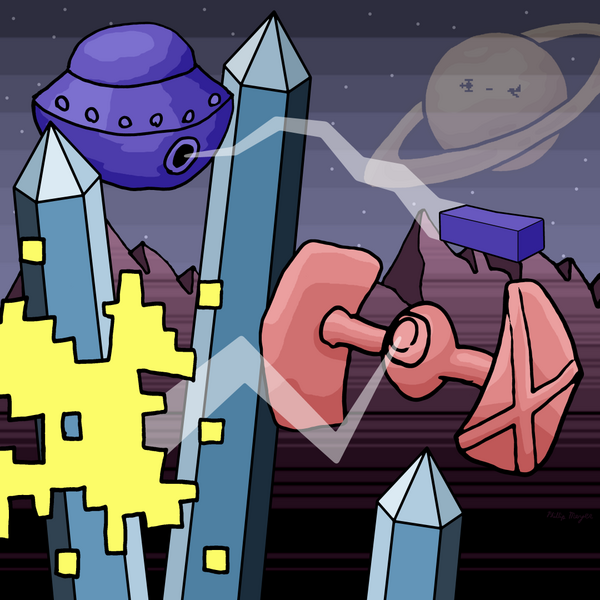
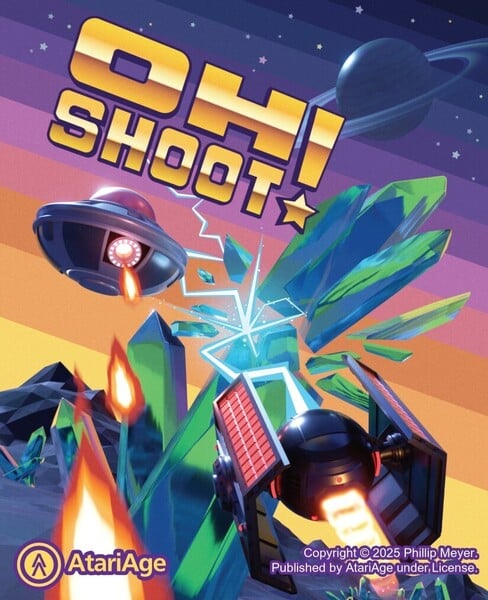
I think it’s pretty cool, and definitely captures the spirit of the game. It shows a Spectre and Destoyer shooting at each other with some of the terrain being blasted away. It also depicts a colorful horizon with Saturn and its rings faded in the background. The same artwork is present on the Box, Cartridge, Poster and Manual. Speaking of the manual, I was really impressed with the sheer volume of information and how well it was all organized. It’s one of the few manuals I remember seeing with a developers corner baked in. The final page of the manual has a scaled down collage showing all the games 1024 combat screens.
Purchasing Information
Oh Shoot! Is available over on Atariage, complete in box for $50. The Rom is currently not available for sale.
Conclusion
Is Oh Shoot! truly a “Combat Killer”? While some reviewers and the developer himself have used that bold claim, I would hesitate to go that far, not because the game isn’t exceptional but because this game takes one of the core components of Combat, arial dogfights, and perfects it carving out it’s own unique category. It is worth noting that the 1977 classic Combat managed to pack 27 game variations into a mere 2KB, whereas Oh Shoot! utilizes a much larger 32K bank switched ROM. I appreciate that it does not require any special hardware on the cartridge to run.
That said, this game is a resounding success in emulating and evolving the Combat formula into a superior 1v1 shooter experience. The more you play, the more you appreciate its depth. It is truly impressive how many ways you can play when you combine the 48 game variations with different player options like manual flight, auto scrolling, and “AI assistance”. While the total number of modes drops to 32 if you set aside the “0-player” exhibition modes, the sheer amount of customization ensures there is a setting for every skill level.
On the surface, the goal never changes. You are simply trying to outshoot your opponent, but the execution makes it incredibly engaging. Thanks to the massive pool of 1,024 unique, random screens and the rotation of four distinct aircraft, no two matches feel identical. This variety creates a “just one more round” mentality that makes you want to come back for more.
Highly Recommended.
Grab your copy:
Oh Shoot! – Atari 2600
William Thorup channel:
Video game critic review:
https://videogamecritic.com/2600no.htm?e=84125#rev6095
Indie Gamer Chick review:
Brians Man Cave reivew: